In Stock
Paintings
SKU: SKU-63
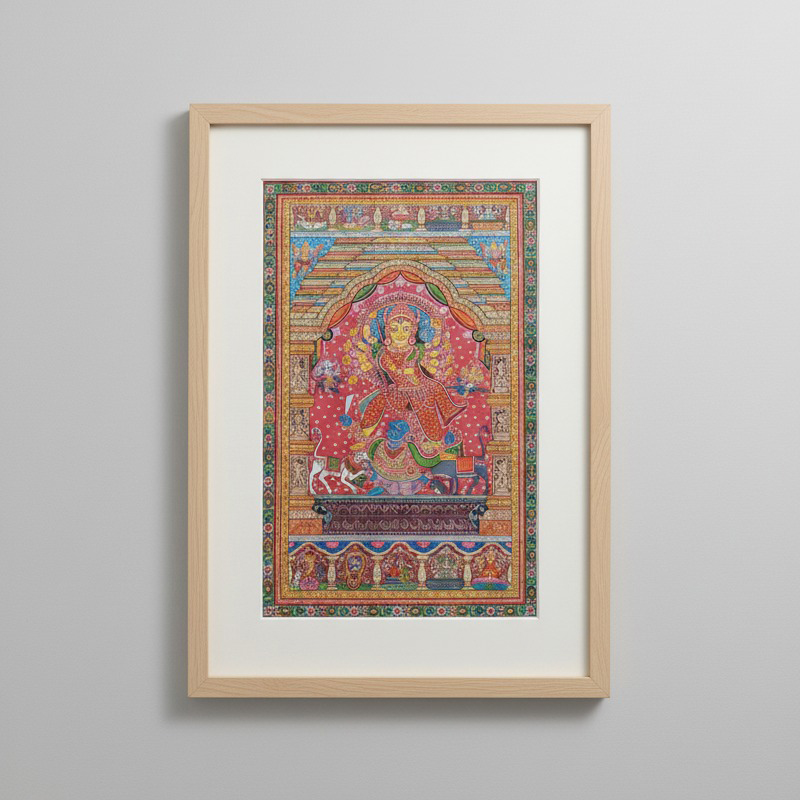
Pattachitra Painting – Lord Narasimha in Sanctum (Framed)
Hand-painted Narasimha with temple architecture and narrative side-panels
grade
grade
grade
grade
grade
(0 Reviews)
Ask for Price
Hand-painted Pattachitra of Lord Narasimha enshrined within a vermilion temple arch, with miniature narrative side-panels and jewel-like border filigree. Natural pigments on cotton; framed with a generous mount.
This museum-grade Pattachitra captures Lord Narasimha—the leonine incarnation of Vishnu—as a towering presence inside a glowing vermilion sanctum. The composition is architectural and ceremonial at once: stepped temple courses rise like a pyramidal roof; a cusped arch, laced with pearl-like dots and leafed vines, frames the deity; slender pilasters to either side carry miniature panels of sages and guardians. The space feels like a shrine you can walk into, yet it also reads as a portable altar you can lift to your wall.
Iconographically, Narasimha stands with heroic poise: a lion’s head crowned with a jeweled kirita, a human torso armored in filigreed ornaments, and limbs alive with rhythmic curves. The painter arrays auspicious attributes with canonical care—the chakra and shankha to the right and left, the gada echoing the strength of dharma, the raised palm in abhaya mudra reassuring the viewer that fear has already been addressed. His eyes are wide and compassionate, not feral; Pattachitra masters understand that Narasimha’s ferocity is medicine, not menace. At the plinth, smaller attendants bow, and a tiny figure—stylized as a devotee rescued—anchors the narrative of protection.
The surface is a festival of line. In Odisha’s Pattachitra, technique is theology: tamarind-seed and chalk size is burnished into the cotton until it accepts pigment like vellum, and then the entire world is built with steady strokes from a squirrel-hair brush. Look closely at Narasimha’s jewelry and you will find constellations of white dots—rekha bindu—tightened with black hairlines so that metal seems to glitter without metallic paint. Fabrics are not shaded but woven into existence with checks, scallops, and cross-hatching. Even the background “emptiness” is active: hundreds of white specks make the sanctum hum with celestial pollen.
Color here is disciplined and symbolic. The vermilion field—lakshmi’s warmth—powers the room like an ember; saffron-gold articulates the body, suggesting both lion’s hide and armor of light; indigo and emerald cool the heat at borders and garments; conch-white picks out halos, eyes, pearls, and the moon-petaled lotus underfoot. The painter balances color fields as a musician balances raga phrases: each return of vermilion is answered by a cooling band; each bright accent is grounded by a dark architectural course. Because pigments are mineral and vegetable—hingula for red, haritala for yellow, indigo, lampblack, conch—they carry a matte dignity that resists glare under glazing and ages with grace.
The left and right margins contain miniature narrative stacks: saintly figures, guardians, and temple reliefs, each the size of a thumbprint but complete in proportion and gesture. These are not filler. They function like a chorus in classical drama, rehearsing the themes of protection, right action, and devotion. The base beam carries a dark frieze—waves, scrolls, or a carved rail—whose tight rhythm reins in the explosion of detail above. Everywhere, repetition creates calm: lotus rosettes, bead chains, leaf-scrolls, and latticework repeat just enough to turn ornament into breath.
Culturally, Narasimha imagery has long been placed at thresholds: it blesses entrances with courage and clarity. This panel honors that lineage while speaking fluently to contemporary interiors. The red core warms neutral rooms; the temple geometry resonates with modern rectangular furniture; and the micro-detail rewards slow, contemplative viewing. In living rooms the painting becomes a conversation catalyst about Indian visual grammar; in pooja corners it acts as a steadying icon; in studies it becomes a visual mantra for focused resolve.
Care is simple but intentional. Avoid direct, harsh sunlight and high humidity; dust the glazing with a clean, soft cloth; if reframing, specify acid-free mounts and UV-protective acrylic or glass. Because the work is entirely hand-painted, minute variations—a bead that sits slightly proud, a vine that wavers by a hair’s breadth—are part of its authorship. These irregularities are not defects; they are the human tempo of craft, the visible trace of hours poured into a steady hand.
What makes this particular Narasimha memorable is the feeling of benevolence inside majesty. The lion face is alert but not wrathful; the body is powerful but proportionate; the borders sing but do not shout. The artist trusts line to do the work of light. Seen from a distance, the piece reads as an icon; at arm’s length, it becomes architecture; up close, it turns into fine jewelry. That triple readability is the hallmark of a master Pattachitra—an object that keeps giving as you keep returning, a shrine that teaches attention by rewarding it.
| Material | Natural stone & vegetable pigments on hand-primed cotton (traditional Pattachitra) |
|---|---|
| Color | Vermilion sanctum, saffron-gold, indigo, emerald, conch-white, lampblack |
| Weight | N/A |
| Dimensions | N/A x N/A x N/A |
| Brand | Artisan |
rate_review
No reviews yet. Be the first to share your thoughts!
Write a Review
Please log in to write a review.
Log InYou May Also Like
View All
Pattachitra Painting – Goddess Durga in Sanctum with Lion (Framed)
No reviews yet
Ask for Price