Made to Order / Contact
Paintings
SKU: SKU-61
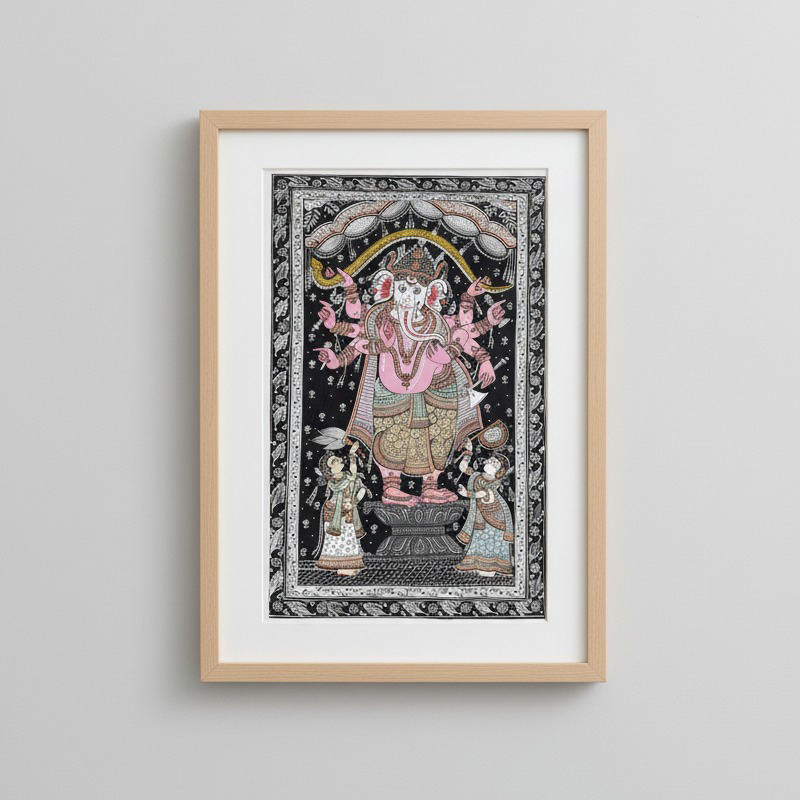
Monochrome Pattachitra – Panchamukhi Ganesha with Attendants (Framed)
Black-and-white shrine painting with subtle blush tones and temple borders
grade
grade
grade
grade
grade
(0 Reviews)
Ask for Price
Price on request. Please contact us for details.
Monochrome Pattachitra of five-aspect Ganesha within a richly patterned shrine; lampblack and conch-white with soft rose highlights. Ideal for pooja corners, entries, and serene study spaces.
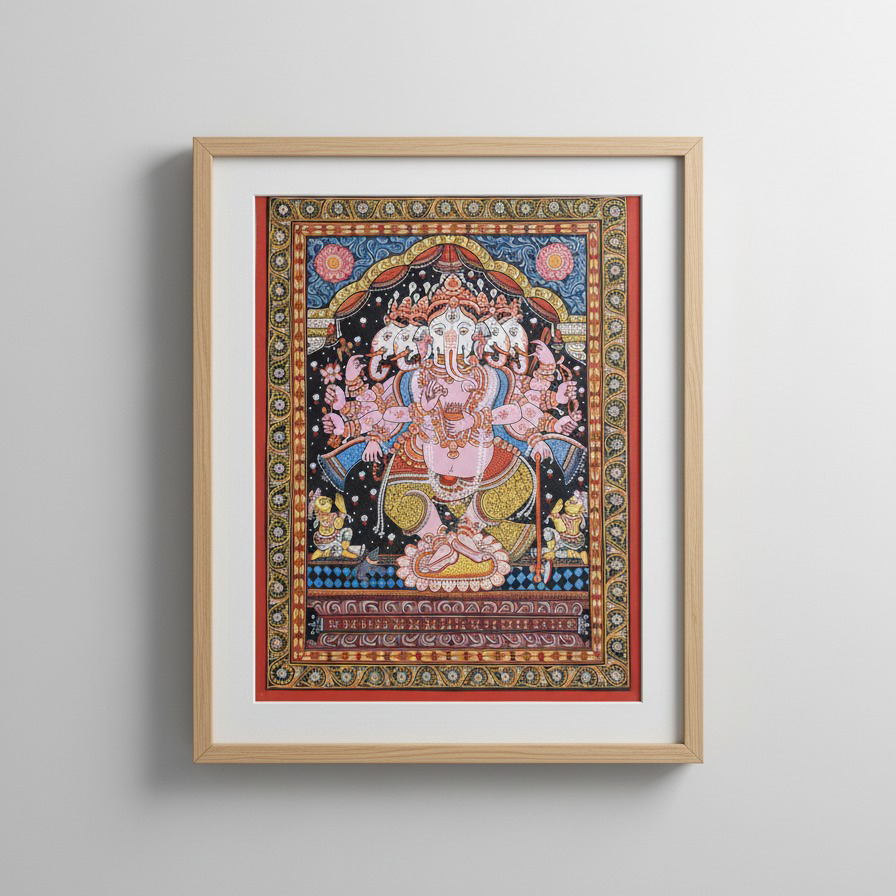
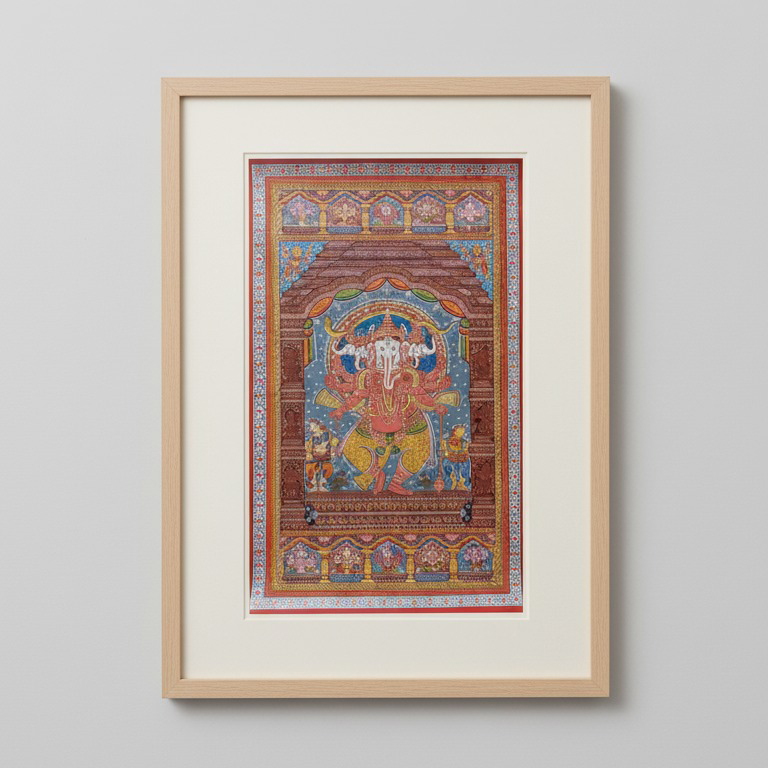
This hand-painted Pattachitra presents Panchamukhi Ganesha—Ganesha with five aspects—enthroned within an ornate sanctum, attended by two devotees bearing ritual implements. Executed in the Odishan monochrome idiom with carefully rationed blush tones, the composition proves how little a master needs to create a world: lampblack and conch-white, a few mineral tints, and a wrist trained to draw lines fine as hair. The black field is not empty; it is a sky of minute stars, each dot a breath from the painter’s hand. Against this night, the deity’s skin carries a gentle rose tint that glows like the inside of a seashell.
At first glance you meet a poised, many-armed Ganesha standing in tribhanga, the triple bend that energizes stillness. Look longer and the iconography unfolds. In one palm he offers abhaya—the gesture of assurance—while other hands hold attributes that readers of the Puranas will recognize: the pasha and ankusha (to gently tether and guide the mind), the parashu (clarity’s axe to cut old knots), the modaka bowl (sweet fruit of resolved effort), the rosary (steady discipline), the script (learning), and the broken tusk, sharpened into a pen by the scribe of the Mahabharata. The vahana, a tiny mouse, waits wide-eyed at the plinth—humble, alert, and essential, a reminder that subtle vehicles carry great realization.
Architecture frames divinity here. A temple arch rises like a woven canopy: scalloped courses, braided vines, pearl-bead fillets, and lotus bands that read as textile more than stone. This is typical of Pattachitra, where the border is not mere trim but an active participant, a sangam of pattern that both encloses and amplifies the center. The painter alternates dense passages with breath: after a run of tight hatching, a small pool of untouched black offers rest. Stars and jasmine buds pepper the heavens; birds tuck into vine scrolls; a pair of guardians look inward from the jambs, keeping rhythm and watch.
Technique makes the sanctity legible. Traditional Pattachitra begins with sizing cotton using a paste of tamarind seed and chalk, then polishing the surface to a vellum-like sheen. Pigments are prepared by hand: lampblack for depth, conch-shell white for light, local earths and minerals for blush tones, bound with natural gums. The chitrakara first maps the figure in a warm underdrawing, blocks color in flat planes, and finally returns with white and black to carve ornament from the fields: beaded necklaces, textile checks, scalloped sashes, and the lace-like rekha that is the school’s signature. Under raking light, the slightly raised white work catches and throws glints, so jewelry seems to sparkle without a speck of metal.
Devotion flows through the smallest details. The attendants at Ganesha’s feet, rendered in restrained palette, hold flywhisks and lotuses; their faces, almond-eyed and serene, tilt toward the deity with a curve that echoes the arch above—a geometry of reverence. On the plinth, tiny scrolls bracket a ritual pedestal; the floor is laid in a check that nods to temple textiles. Even the negative spaces are composed, speckled with micro-stars so that night itself appears woven. A viewer standing at three meters sees an icon; at one meter, architecture and procession; at thirty centimeters, a biography of brushstrokes, each precise and patient.
Symbolically the painting condenses a theology of beginnings. Five faces signify comprehensive awareness turned to every horizon; the circle of the halo nested within the arch’s stepped triangle rehearses a classic Indian diagram—circle (consciousness) housed in square/triangle (cosmos). The mouse, often misread as appetite, becomes in this idiom a teacher of subtlety and passage through narrow gates; wisdom does not always arrive in thunder. The monochrome choice is not merely aesthetic: it disciplines the eye to read form, proportion, and gesture without the seduction of color, much like the way a raga rendered without accompaniment reveals the architecture of melody.
For contemporary interiors, this piece is remarkably adaptable. The cool black-and-white field sets up an elegant dialogue with warm woods, concrete, stone, and linen; the gentlest hint of rose keeps it from austerity. In a pooja nook it serves as daily darshan; in a study it becomes a visual mantra of focus and grace; in a foyer it blesses thresholds—the classic domain of Vighneshwara, remover of obstacles. The frame pictured—a clean, pale timber with generous mount—lets the border breathe; if you reframe, choose UV-protective glazing and acid-free mounts to preserve the minerals’ natural brightness.
Care is minimal but mindful: avoid direct sunlight and high humidity; dust the glazing lightly with a soft cloth; never spray cleaner directly on the surface. Because each Pattachitra is drafted freehand, micro-variations—a slightly irregular bead, a dot that sits higher than its neighbor—are not defects but signatures of time made visible. In this work, seek the fine curl of Ganesha’s trunk and the whisper-thin outline along the halo—both testaments to training transmitted across generations in coastal Odisha.
As an object, the painting delivers three gifts. First, aesthetic pleasure: a harmony of line, proportion, and pattern that continues to reveal new correspondences the longer you look. Second, cultural continuity: you participate in sustaining an artisan ecology that still grinds pigments, sizes cloth, and teaches wrists to breathe steady dots. Third, auspicious function: Ganesha’s presence has always been less about superstition than about psychology—begin with clarity, remove avoidable obstacles, and move with gentle resolve. This Pattachitra makes that counsel visible: ordered, rhythmic, and luminous within deliberate limits—black and white, line and dot, circle and arch.
| Material | Lampblack, conch-shell white & natural earth pigments on hand-primed cotton (Pattachitra) |
|---|---|
| Color | Monochrome (black/white) with soft rose and muted gold accents |
| Weight | N/A |
| Dimensions | N/A x N/A x N/A |
| Brand | Artisan |
rate_review
No reviews yet. Be the first to share your thoughts!
Write a Review
Please log in to write a review.
Log In